
UV Printed Enamel Effect VS Traditional Enamel Filling | High-Quality Custom Promotional Products for Corporate Branding | Jin Sheu
Jin Sheu is a high-quality Lapel Pins, Challenge Coins, Medals and Medallions, Keychains, Military Medals Ribbon Drapes, Car Grille Badges Auto Emblems, Personalised Golf Gifts, Woven Patches, Embroidery Patches, Leather Patches and Labels manufacturer from Taiwan since 1984. With 40 years Gift and Premiums Items manufacture and export experience, Jin Sheu is specialized manufacturer and exporter for custom made lapel pins, medals, commemoratory coins, key chains, buckles, police badges as well as other promotional giveaway items.
UV Printed Enamel Effect VS Traditional Enamel Filling
Jin Sheu introduces a new application of UV printing that can recreate the visual appearance of traditional soft enamel and imitation hard enamel on metal products such as custom lapel pins, challenge coins, metal keychains, award medals, military badges, and more.
Compared with conventional enamel filling, the UV printed enamel effect offers a more economical and production-efficient alternative. It is particularly suitable for large-volume orders, price-sensitive promotional programs and projects that require a shorter production schedule.
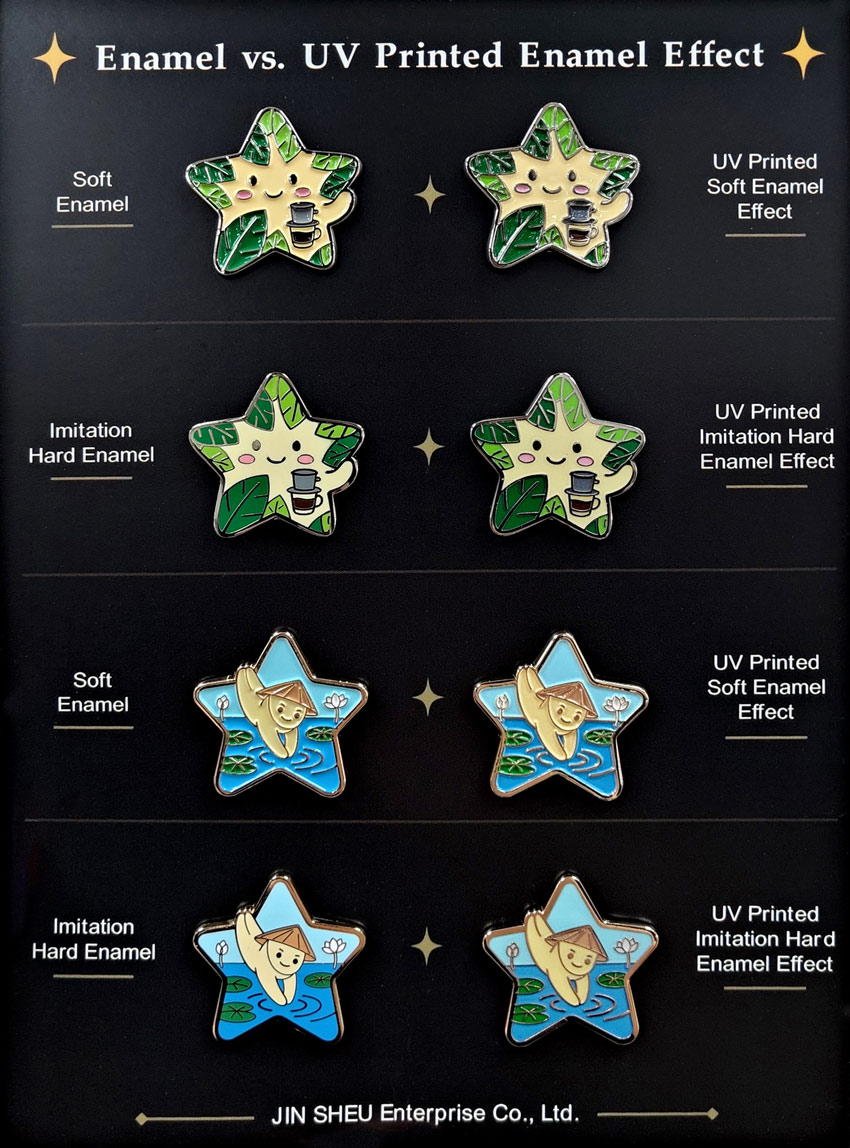
However, UV printing and traditional enamel filling use different color systems and should be selected according to the project’s priorities. To help customers evaluate the difference more clearly, we have produced a physical comparison sample card showing the two processes side by side.
Soft Enamel and Imitation Hard Enamel VS UV Printed Enamel Effects
 Traditional soft enamel filled star-shaped pin with recessed colors and raised metal borders.
 Traditional imitation hard enamel pin with smooth colors level with the metal borders.
 Gold-plated star-shaped lapel pin with traditional soft enamel filled scenic artwork.
 Gold-plated custom pin with smooth imitation hard enamel filled scenic artwork.
 UV printed soft enamel effect recreating recessed colors and raised metal details on a custom logo pin.
 UV printed imitation hard enamel effect with a flat-looking finish on a custom metal pin.
 UV printed soft enamel effect on a gold-plated star pin with colorful scenic artwork.
 UV printed imitation hard enamel effect on a gold-plated star-shaped custom pin.
What Is the UV Printed Enamel Effect and Its Advantages?
The UV printed enamel effect uses UV printing to apply colors directly to a prepared metal surface, then cures the ink with ultraviolet light. By controlling color areas and surface levels, it can mimic either soft enamel (recessed color with raised metal borders) or imitation hard enamel (flatter, polished look), while remaining a printing process rather than traditional enamel filling.

Key advantages: More economical for large orders: Reduces manual coloring work, offering a more competitive unit price for high-volume or budget-sensitive projects.
Faster production: Digital UV printing applies all colors in one pass, generally speeding up the coloring stage compared with filling multiple enamel areas.
Suitable for detailed artwork: Reproduces fine lines, small details, multiple colors, and gradients that are difficult with traditional enamel, and can reduce the need for metal borders between color areas.
The Main Difference: PMS Color Accuracy
The most important difference between these two methods is color matching. Traditional enamel colors can be individually mixed according to specified Pantone Matching System colors. This makes traditional soft enamel and imitation hard enamel more suitable when accurate corporate or brand color reproduction is a priority. UV printing produces colors through a CMYK-based inkjet process. The printer combines cyan, magenta, yellow and black inks to simulate the requested color. Because the printable CMYK color range differs from the Pantone color system, some PMS colors cannot be reproduced exactly.

As a result, UV printed colors may show visible differences in hue, brightness or saturation when compared with a physical Pantone color guide. Screen displays, metal plating, white ink layers and surface finishing may also affect the final appearance. For projects using UV printing, PMS references should therefore be treated as target references rather than guaranteed exact color matches.
UV Printing or Traditional Enamel: Which Should You Choose?
UV printing and traditional enamel filling offer different advantages depending on the project. UV printing is generally better suited to cost-sensitive bulk orders, shorter production schedules, and artwork containing fine details or gradients. Traditional enamel filling remains the preferred option when precise PMS color matching and a genuine enamel-filled construction are essential. Use the comparison below to identify the process that best matches your artwork, budget, quantity, and color requirements.

Frequently Asked Questions About Traditional Enamel vs. UV Printed Enamel Effects
- Q1: What is the main difference between traditional enamel and a UV printed enamel effect?
- A: Traditional enamel uses individually mixed colors that are filled into defined metal areas. The UV printed enamel effect applies CMYK-based ink directly to a prepared metal surface and cures it with ultraviolet light. It creates an enamel-style appearance but remains a digital printing process.
- Q2: Can UV printing look like soft enamel?
- A: Yes. UV printing can reproduce the appearance of recessed color areas surrounded by raised metal borders. However, the color is printed rather than physically filled with traditional soft enamel.
- Q3: Can UV printing imitate hard enamel?
- A: Yes. The printed surface can be arranged to create a flatter, smoother appearance similar to imitation hard enamel. At close range, subtle printing dots or surface differences may still be visible.
- Q4: Which process provides more accurate PMS colors?
- A: Traditional enamel provides more precise PMS color matching because each color can be mixed individually. UV printing uses CMYK inks to simulate the requested PMS color, so differences in hue, brightness or saturation may occur.
- Q5: Is the UV printed enamel effect more economical?
- A: It is generally more economical for multicolor artwork, large-volume orders and budget-sensitive projects because it reduces the manual work required to fill individual enamel areas. Final pricing still depends on the artwork, product size, quantity and finishing requirements.
- Q6: Is UV printing faster than traditional enamel filling?
- A: UV printing generally speeds up the coloring stage because multiple colors can be applied digitally during the same printing process. Traditional enamel requires separate color filling, curing and, for imitation hard enamel, grinding and polishing.
- Q7: Which process is better for detailed artwork?
- A: UV printing is better suited to fine lines, small text, gradients, photographic elements and complex multicolor graphics. Traditional enamel requires clearly defined color areas and metal borders between adjacent colors.
- Q8: Is a physical sample recommended before bulk production?
- A: Yes. A physical sample is especially important for UV printed projects involving brand-critical colors. PMS references used for UV printing should be treated as target colors rather than guaranteed exact matches.
- Q9: Can a protective coating be added over UV printing?
- A: Depending on the product and design, a clear epoxy coating may be added to protect the printed surface and create a smooth, glossy finish. The appropriate finishing method should be confirmed during artwork review. Learn more about Jin Jumbo’s UV printing process.
- Video
Presenting theUV printing enamel effect against the traditional enamel color filled samples side by side allows buyers to compare color, surface appearance and overall visual effect under the same lighting conditions. The card also demonstrates why an on-screen artwork preview alone cannot fully represent the final result. When color accuracy or surface appearance is especially important, we recommend reviewing a physical sample before approving bulk production.
- Downloads

UV Printed Enamel Effect and Enamel Filled Comparison Sample Card
To make the differences easier to understand, Jin Sheu has created a physical sample card using the same artwork across the enamel color fill and UV printed...
Download

Hot Products

 Download
 UV Printed Enamel Effect VS Traditional Enamel Filling | High-Quality Custom Promotional Products for Corporate Branding | Jin Sheu
Located in Taiwan since 1984, Jin Sheu Enterprise Co., Ltd. has been a business promotional products manufacturer and exporter. Their main promotional products and giveaway items include, metal souvenir items, enamel pins, initial keychains, printed lanyards with badge holders, silicone bracelets and wristbands, woven and embroidered patches and trolley tokens and coins, which can be customized and personalized to meet international eco friendly and safety standards.
Jin Sheu Enterprise founded in 1984, is a leading manufacturer for custom enamel pins, metal bookmarks, military medals and ribbons, walking stick medallions, custom police badges, and grille badges. With a manufacturing site of over 64,000 square meters and 2000 sophisticated workers, plus the latest automatic electroplating plant and soft enamel color dispensing machines, we surpass our competitors in delivery time, quality, and service, especially for the large quantity required shortly or complicated designs needed experienced workers, Jin Sheu is the number one choice as we are equipped to offer integral service. Our China factory passes the audits and acquires authorization from Disney, McDonald's, and Sedex. Annually, we provide 30~35 different raw material test reports to prove our products comply with the benchmark of USA and EU regulations.
Jin Sheu has been offering customers business promotional giveaways, both with high-quality manufacturing processes and 40 years of experience, Jin Sheu ensures each customer's demands are met.